Saturday, July 9, 2011

Segonzano, Asiago, Valsugana

Mountains in Trentino

Visiting Lucia and Marta in Segonzano was easily one of my favorite adventures this year. Away from the hustle and bustle of the cities, one can breathe deep and enjoy the majesty of the mountains and forests of Northern Italy. For background info about Segonzano and Lucia, written last year on my first visit to Trentino, click on this link:

2010/10/segonzano

After getting settled at the Environmental Center where they live, we drove to a nearby spot for a stroll around the lake, followed by pizza.

Lucia and Marta awaiting our pizzas

The next day, Lucia took us up to Parco Naturale, Paneveggio di San Martino for an afternoon of hiking. When I look at the photos of that day, I long to return to witness more of the mountain beauty.

Parco Naturale, Paneveggio di San Martino

The Dolomites in the background

We hiked for several hours up to a spot where we stopped for a picnic lunch. We could hear the music of cowbells below us, as a herd of cattle grazed upon the mountain grasses. After lunch, we found ourselves amidst a herd of sheep grazing near our picnic spot.

Lucia amidst the sheep

After our hike we visited the Paneveggio di San Martino, where there is a forest famous for its spruce trees, used to make violins and other wood instruments. Their website, parcopan. org explains:

The forest is a big area (2700 hectares) in the northern section of the Park covered by woods of spruce firs. These well-structured and ecologically complex conifer woods with very high trees (over 40 metres) and with such an extension are rare in Europe. However, this forest is also well-known all over Europe for another reason, and famous violin makers come and visit it: since its trees (the so-called "abeti di risonanza"
, or resonance firs) are particularly suitable for the production of violins which assume a particular resonance, this forest is called "La Foresta dei Violini" (The Forest of Violins).

The next day, Luciano joined us for a drive to the Altopiano (a mountain plateau area) in the Veneto region. It was a misty, cloudy day, and we were chased by thunderstorms throughout our journey. We stopped in the city of Asiago, famous for its cheese and nearby ski slopes. Although probably best known internationally for its cheese, Asiago was also the site of a major battle between Austrian and Italian forces in World War I. While there, we visited the Asiago Military Memorial, which contains the remains of 60,000 Italian and Austrian soldiers.

From the photo below you can see the definite Austrian influence on the architecture of this region. The wide clean streets and tall church spires provide a distinct contrast to other regions of Italy.

AsiagoAsiago street scene

We had a wonderful afternoon driving through various mountain and valley towns, then stopped in Borgo Valsugana, a picturesque village, for gelato.

Borgo Valsugana

Luciano, Lucia and Marta

During my stay in Segonzano, one of Lucia and Marta's fondest wishes was to make a cheesecake, a dessert they enjoyed last year on their first visit to the United States. So we assembled a reasonable facsimile of ingredients. Though cream cheese is easy enough to find in Italy, graham crackers for the crust are not, so we used crushed digestive biscuits instead, which worked out fine. In fact, our efforts were a huge success, and the resulting cheesecake tasted as good as any I've had in the States.

Cheesecake Italian style!

My stay in Segonzano with Lucia and Marta was all too short: they are delightful company and it was refreshing and invigorating to be in the midst of mountains and forests. I can't wait to go back for another vistit!

Friday, July 8, 2011

Verona

I had a short and sweet time in Verona, spending one night in a hotel near the main Piazza Bra and the famous Roman Arena where opera and music concerts are often performed.

Piazza Bra and the Verona Arena

And of course, Verona is also known as a city of romance, the home of Romeo and Juliet, and many people come to see a balcony attributed to the Shakespeare scene where Romeo visits Juliet. Though the balcony was added to an old building in 1936 to create a tourist attraction, no one seems to care that it's just a come-on.

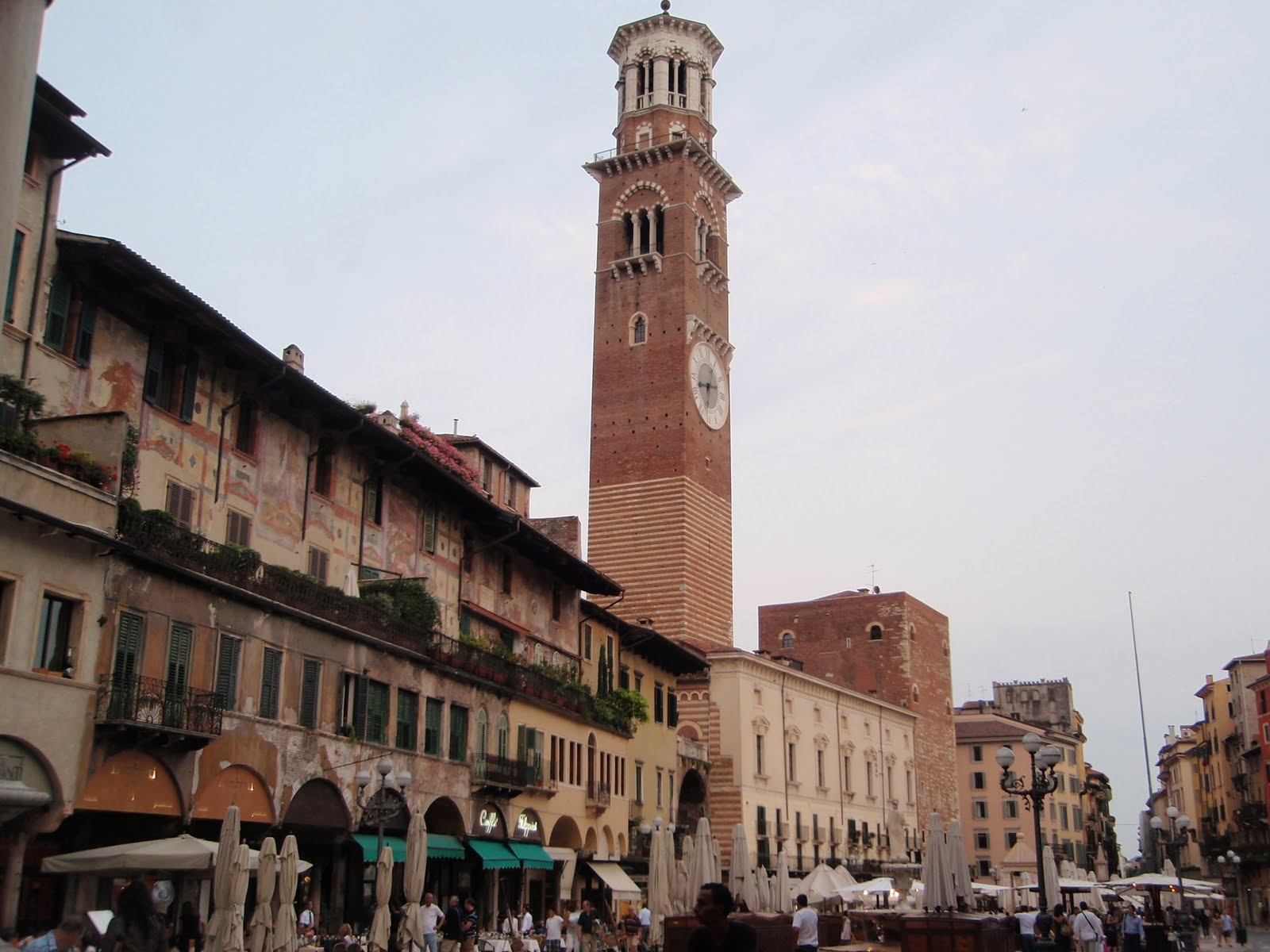
Torre Lamberti in Piazza L'Erbe

Two things that I really enjoyed: climbing 368 steps to the top of the Torre Lamberti, and visiting the Roman Theater early in the morning when no one else was there.

View of Verona from Torre Lamberti

view of Verona from Roman theater

view of Verona and Adige River

That night there was a Ricky Martin concert in the Arena, but instead, I headed across town to a free concert of Tango music, performed by a 5-man group from the music conservatory. The concert was held under the stars, in a cloister of Verona's beloved church, Sant'Anastasia. An Italian man sat next to me, and we chatted off and on during the evening. After the concert, he invited me to have a glass of wine, and we had a nice time talking. Around midnight, he wanted to drive me up into the hills to see Verona from above, but he was a bit too eager, and I was unsure of his intentions, so I declined. I suggested that we walk through the quiet streets of Verona back to my hotel, which didn't appeal to him, and so we parted ways. Still, it's a nice memory to have been courted for a few hours in Verona by an attentive Italian man.

I enjoyed my stay in Verona, and would like to return some summer day to attend a Puccini opera in the Arena.

Sunday, July 3, 2011

Nemi

Nemi

After Deborah arrived back home, we drove to Nemi for lunch one day. It's a lovely, quaint town in the Alban Hills, one of the Castelli Romani. It sits perched above Lake Nemi, and across the Lake you can see Castel Gandolfo, the Pope's summer residence.

In antiquity the grove around the lake was the site of one of the most famous of Roman cults and temples, that of Diana Nemorensis, also known as "Diana of the Wood." Some poets referred to Lake Nemi as “Diana's Mirror.”

Nemi is famous for its wild strawberries, which are smaller and sweeter than commercially grown varieties. Nemi's strawberries are grown on the sides of the volcanic crater, which creates a microclimate that retains the warmth of the sun and provides a wind shield.

We ate a delicious lunch at one of Deborah's favorite trattorias, and the food was incredibly satisfying. Too full for dessert, we bought a few tarts made with Nemi's wild strawberries and they were elegantly packaged for us to take home.

They were so exquisite, we savored every bite, and I wish we had bought more than one apiece. Now I have a good reason to go back to Nemi.

Saturday, July 2, 2011

Italia Nord

My housesitting gig in Zagarolo is coming to an end and I'll be heading out soon for points north, to visit friends, visit a few favorite places and see a few new ones. First stop, Verona, in the Veneto region. After that:

Segonzano (Trentino-Alto Adige) to visit friends Lucia and Marta
Padova (Veneto) never been there
Venezia (Veneto) want to go again
Modena (Emilia-Romagna) to visit friends Marco and Marvi
Cremona (Lombardy) never been there
Firenze (Toscana) cause I love it!
and back to Zagarolo (Lazio)

I'll have my netbook with me, but may be too busy to blog...

ci vediamo presto!
see you soon!

Friday, July 1, 2011

Two Greedy Italians

Gennaro Contaldo and Antonio Carluccio

Here's the new Odd Couple: two aging Italians who made their fame as chefs in England, now have a BBC show, and I'm loving it! On the show, they travel around Italy visiting various regions, on a mission to find out how Italy has changed since they lived here some 40 years ago.

It's a refreshing change from the usual Italian cooking show, as they cook simple meals while they travel, often using a hotplate or an open fire to create their masterpieces. And they are a hoot to watch! Gennaro is a cut-up, always riding the older Antonio and giving advice, while Antonio merely wants to be left alone.

Each episode focuses on a different region of Italy, where the two men explore cities and villages, interviewing locals about how life has changed (or not) in Italy, especially in regards to food and family. The show really captures the beauty of Italy, and the friendship between the two hosts adds a unique and poignant touch.

So far, 4 episodes have aired, and all can be viewed, albeit in pieces, on YouTube. Here's a link to their first episode:  oops! it's no longer available!


Tuesday, June 28, 2011

I gatti

Where's our grub?

I've been remiss in not introducing my companions in Zagarolo: i gatti, the seven cats that I'm here to take care of. Seven may seem like a lot, but six of the cats live outside and are no bother: they only need food and water twice a day. The seventh cat, Nina, lives in the house, and is the principessa of the group. However, another cat, Tina, is my favorite. She's old and arthritic, but still dainty and sweet. Several of the male cats eat a special food mix, due to renal problems, but mostly they're an easy bunch to care for. Here's some photos of the crew:

Tina

Nina

Tigre and Botsy playing

il grande Ciccio

Gianni and Bella in their favorite hangout

Monday, June 27, 2011

Food of the Gods (and Goddesses)

Figs!
Suddenly, I have a bumper crop of fichi (figs) on my hands. I've never had fresh figs before, and with such a quantity, I've been doing research to find some recipes that don't involve using them for jam or desserts. To my delight, I've found many that pair figs with prosciutto or cheese, and suggest using them in salads and on pizza.

Did you know that the fig is one of the first plants cultivated by humans? Fig fossils dating back to 9400 BC prove it! It's even believed that they could have been planted and cultivated intentionally, one thousand years before wheat and rye were domesticated. Figs also served as a common food in Roman times. And as for nutrition, figs are one of the highest plant sources of calcium and fiber. But they also have a laxative effect, so it's best not to eat many at one time.

(postscript: later, I learned that this crop of figs is basically of no value. Usually, they drop to the ground and are not used. In September, the sweeter figs arrive, the settembrini, which are much juicier and sought after.)

I have some other beauties in the yard, including melagrana (pomegranate), which are just starting to form their fruit, as shown below.

I neglected the carciofi (artichoke), but now have a lovely plant to watch as they go to seed.

And these aren't plants, but I enjoy their shape: demijohns once used to store wine, that were rescued from rubbish bins.