castel-san-pietro-romano
Thursday, June 16, 2011
Romans come to visit
castel-san-pietro-romano
Wednesday, June 15, 2011
A visit to the Cantina
After our trip to Tivoli, we stopped in at Cantina del Tufaio to visit the real cantina (wine cellar) where the white wine is stored. The cantina was dug out of the tufa rock by Claudio's grandfather in 1850, and serves as the perfect cooler to store the wine while it ages.
After visiting the cantina, we sat under the pergola on their patio and tasted a new bottle of their Spumanti, along with ciambelle (cookies made to be eaten with wine), bread and last year's olive oil. One of Claudio's winemaking friends stopped by to have his wine "tested" by Claudio, and we all had a glass of that as well. Since everyone was Italian but me, as the conversation sped up, it quickly moved beyond my comprehension level. But I enjoyed the chance to while away the afternoon with several groups of friends, brought together by yours truly!
Monday, June 13, 2011
Tivoli: Villa Adriana
While my friends were here from Modena, I drove them to Tivoli, a 30-minute drive from Zagarolo. We went to see Villa Adriana, which was built as a retreat for the Roman Emperor Hadrian between 125 and 134 A.D. In the later years of his rule, he governed the Roman empire from the Villa. It has been designated as a UNESCO World Heritage site.
We spent several hours walking through the vast complex, which covers 250 acres and includes some 30 buildings: palaces, terme (baths), a theatre, temples, libraries, state rooms and living quarters.
Hadrian was involved in creating the architecture of the estate from his own ideas, and the style of the statues, sculpture and mosaics were inspired by his travels to Greece and Egypt. The Villa still preserves the grandeur and splendor of the ancient Roman world. Hadrian was also responsible for building the Pantheon in Rome.
One of the most striking and best preserved parts of the Villa is a pool, named Canopus after an Egyptian city. There is a grotto at one end called the Serapeo. This was my favorite part of the complex: I found the green of the trees on either side, and the long expanse of green water to be both mesmermizing and relaxing.
After our long walk through the vast complex of the Villa, we stopped for pranzo (lunch) at a restaurant on the premises and had another delicious Roman meal. (I can feel the pounds creeping on!) Unfortunately, by this time we were weary, and still had a date to visit the Tufaio winery, so we didn't make it to another villa in Tivoli, Villa D'Este, famous for its fountains and flower gardens. It will have to wait until another day.
Sunday, June 12, 2011
A gift and guests from Modena
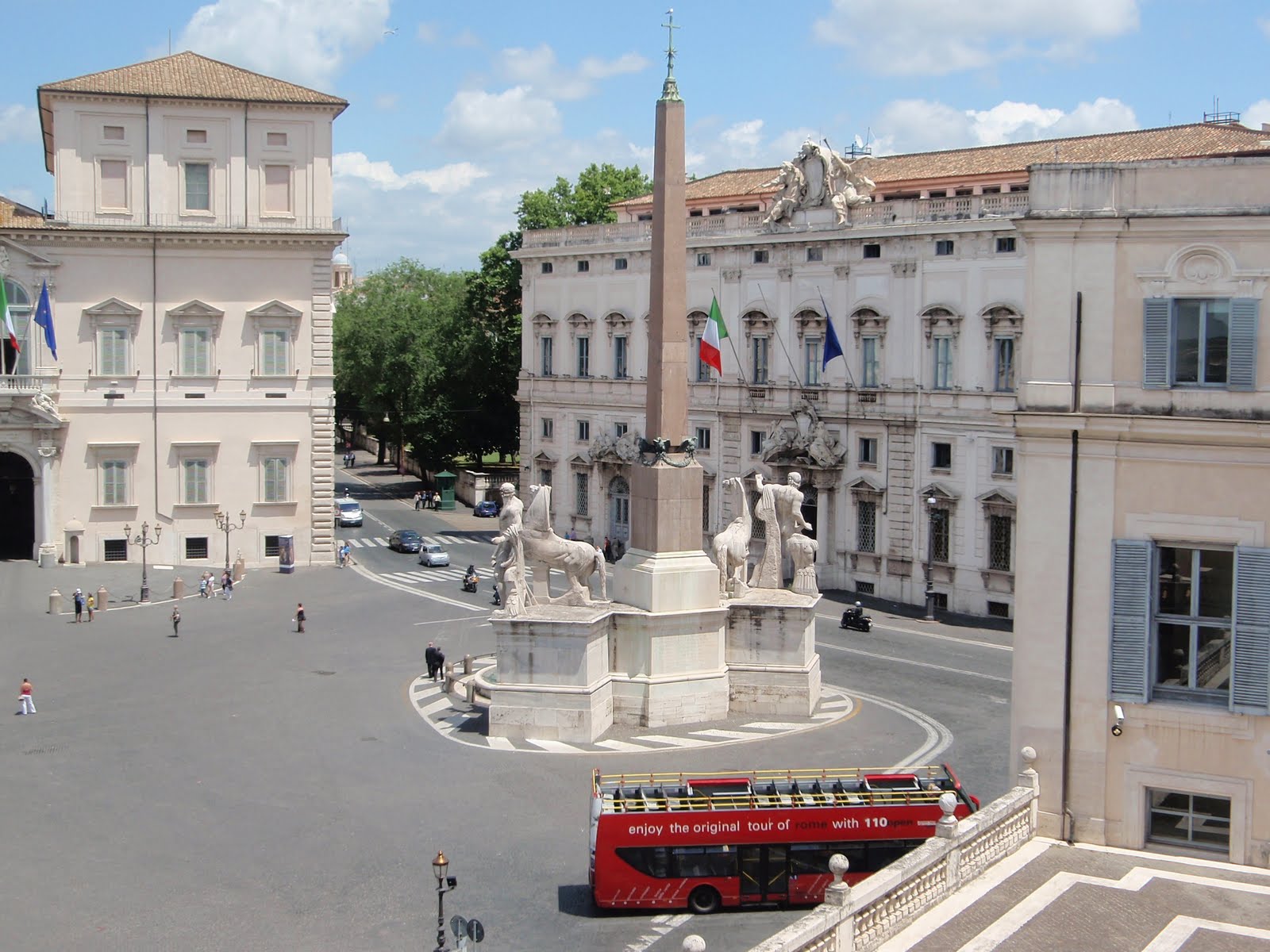
This week I had visitors from Modena: Marco and Marvi came to spend a few days with me in Zagarolo. I met them in Rome at the Termini train station, and we headed down via Nazionale and over to the Scuderie del Quirinale to see an art exhibit by Lorenzo Lotto. (Across the piazza is Palazzo Quirinale, the official residence of the President of the Italian Republic, currently Giorgio Napolitano.)
I was not familiar with the artist Lotto, originally from Venice, who was considered eccentric and independent from his cohorts, who included Bellini, Rafael and Bramante. Due to recent restorations of his work, the colors were vibrant, and I found the exhibit to be powerful and impressive. For more on Lotto, click this link:
Lorenzo_Lotto
When we returned to Zagarolo, after giving a tour of the house and yard, I made my new specialty, gnudi for la cena (dinner). It turned out quite well! And for dessert, a special Cherry-Olive Oil Polenta cake that I'd made in honor of Marco's upcoming birthday.
The History of Balsamic Vinegar
Balsamic vinegar is today used in numerous recipes all over the world. The tangy sweet and sour flavor of balsamic vinegar gives a marvelous finish to gourmet delicacies. Having its origins in the Emilia-Romagna region of Italy, balsamic vinegar has found its way into the smallest of home-kitchens as well as the trendiest of restaurants. One finds the shelves of supermarkets stocked with various brands of balsamic vinegar each claiming their own superiority. An average customer is unaware of the fact that authentic balsamic vinegar is very difficult to come by. Most of the commercial varieties available in the markets are manipulated versions or imitations. It would therefore not be surprising if we say that most people have not even tasted authentic balsamic vinegar.
Thirty years ago true balsamic vinegar, (or in Italian) “aceto balsamico tradizionale,” was relatively unknown outside of villas of Italy. Till this time, its production was restricted to the wealthy families in the small towns of Modena and Reggio in the Emilia-Romagna region, just west of Bologna. They had been making the condiment for nearly a thousand years but catering only to the requirements within the family. They would stock supplies for several years and pass on to the next generation as heirlooms. It was also a prestigious gift given in small vessels to close friends or bequeathed to daughters as a portion of their wedding dowry.
Grazie a Marvi! Now if I can only get the bottle home to Kansas without breaking it!
Saturday, June 11, 2011
Gallicano nel Lazio
Monday, June 6, 2011
Le vigne
Vineyards
Today I went across the road to la vigna (vineyard) and cantina (wine cellar), called Cantina del Tufaio, to learn something about the grape-growing process. Claudio and Mariela were working on the vino rosso (red wine) vines under the hot morning sun, trimming away leaves that were shading the baby grape clusters, and tucking the long tendrils of vine up under the overhanging wire. They were explaining things quickly to me in Italian, so I wasn't able to follow everything they said, but I got the gist of it.
After a wind and rain storm yesterday, they were working hard to "clean" the vines before another storm that is predicted for this afternoon. Only the vino rosso vines need to be cleaned in such a way. The vino bianco (white wine) vines are treated differently: the vines are cut at the top, and the leaves are left to shade the grape clusters.
They were working in the newer vineyard, planted ten years ago, which contains one section of grapes for red wine (cabernet sauvignon) and another for white wine (chardonnay).
Their older vineyard, down the street, was planted in the early 90's. Mariela took me on a tour of this more expansive tract, which curved downwards along the hill and up the other side. The views were simply breathtaking. This tract contains a variety of grapes for other types of wine, spumanti, and merlot. These grapes were much larger, and will be harvested in mid-August. Beyond the merlot vines is an olive orchard, and beyond that is a walnut orchard.
Mariela told me that most of the houses in this area are relatively new, meaning about 50 years old. But the house where the cantina is located predates all the newer construction, as it was built in 1936. Houses that are older have often been refurbished with stucco on the outside, and small patches of the original stoneware are visible to show their more ''antique" origins.
I'm wishing I could be here in the fall to see the vendemia (grape harvest). Chissa? Forse posse ritornare...
Today I went across the road to la vigna (vineyard) and cantina (wine cellar), called Cantina del Tufaio, to learn something about the grape-growing process. Claudio and Mariela were working on the vino rosso (red wine) vines under the hot morning sun, trimming away leaves that were shading the baby grape clusters, and tucking the long tendrils of vine up under the overhanging wire. They were explaining things quickly to me in Italian, so I wasn't able to follow everything they said, but I got the gist of it.
After a wind and rain storm yesterday, they were working hard to "clean" the vines before another storm that is predicted for this afternoon. Only the vino rosso vines need to be cleaned in such a way. The vino bianco (white wine) vines are treated differently: the vines are cut at the top, and the leaves are left to shade the grape clusters.
They were working in the newer vineyard, planted ten years ago, which contains one section of grapes for red wine (cabernet sauvignon) and another for white wine (chardonnay).
Their older vineyard, down the street, was planted in the early 90's. Mariela took me on a tour of this more expansive tract, which curved downwards along the hill and up the other side. The views were simply breathtaking. This tract contains a variety of grapes for other types of wine, spumanti, and merlot. These grapes were much larger, and will be harvested in mid-August. Beyond the merlot vines is an olive orchard, and beyond that is a walnut orchard.
Mariela told me that most of the houses in this area are relatively new, meaning about 50 years old. But the house where the cantina is located predates all the newer construction, as it was built in 1936. Houses that are older have often been refurbished with stucco on the outside, and small patches of the original stoneware are visible to show their more ''antique" origins.
I'm wishing I could be here in the fall to see the vendemia (grape harvest). Chissa? Forse posse ritornare...
Thursday, June 2, 2011
Cherries galore!
Though today was a holiday in Italy, as Italians celebrated the 65th anniversary of their independence day, it was just another day for me. I'd been to Rome earlier this week, so decided not to hassle with the city scene. Instead, I spent much of the day picking, pitting and cooking cherries.
After four glorious but hectic days in Firenze, I was ready to come back to the tranquil setting in Zagarolo. I'm enjoying my time here more and more. One of my routines is to take an hour-long walk down a country road, with views of vineyards and hills in every direction. I can watch the changes in the vegetation, and was surprised this week to see how much everything had grown while I was in Florence. Wildflowers of all types, colors and sizes had popped out, including orange poppies, blue chickory, white Queen Anne's lace, and pink primrose. In the yard, other varieties of wildflowers are blooming, along with the oleander and pomegranate bushes. (yes, a pomegranate! It has bright orange flowers. Who knew?)
And the two cherry trees are loaded down with cherries. There seems to be no end to them! I've been picking about 4 pounds of ripe cherries every day for the past four days, and there's no end in sight. I've made several cherry cobblers, am planning to make a Cherry-Olive Oil Polenta Cake for friends who are coming next week, and tonight I'll try my hand at cherry jam for the first time ever. As for the rest, I'll probably freeze as many as I can for Deborah to enjoy when she comes back. I've also been eating them by the handful; they're just too good to pass up. However, many of them will go to waste, as the trees are too high for me to reach all the branches. When I took a tray of cherry cobbler to one of my English students, I returned with zucchine and gigantic mulberries from their garden. Nice trade!
One of the best things about house-sitting, as opposed to renting, is that I have access to a fully equipped kitchen, complete with a cherry-pitter and all the other utensils I need to cook, bake, make pasta, jam or whatever else suits my fancy. However, there's no food processor, so I have to beat the cake batter and chop by hand, and I'll be using a mortar and pestle to make pesto when the basil is ready. And then there's the garden: I have fresh lettuce, arugula, artichokes, basil, and soon, tomatoes! I am so thankful to have such a lovely home in such a beautiful setting to take care of for several months.
Subscribe to:
Posts (Atom)