Friday, March 2, 2012

Making Risotto:a work of art

© 2010 - 2012 Easy Gourmet Dinners, KLZ.
I'll admit it: cooking is not my fortè. In fact, I've avoided the culinary arts most of my life because of the genetic tendency to gain weight that plagues my family of origin. I often have trouble enjoying  a good meal, knowing that it can easily lead to tight clothes and regret. But once in a while, I manage to get excited about cooking, and one dish that I am learning to master is risotto.

Tonight I made an asparagus risotto. This is not just any asparagus risotto, but one that also includes saffron, lemon zest, lavender shallots, and finely minced carrots. And of course, the usual risotto-making ingredients: Arborio rice, chicken broth, white wine and parmagiano cheese. Squisito! Since writing about food and cooking is also not my fortè, I'm not about to include the recipe, but I will say that it's one of many fabulous risotto recipes in Marie Simmons' book, The Amazing World of Rice.

There's just something about the process of making risotto that is immensely enjoyable: for me, it's akin to creating a fine work of art. And once you master the basic risotto recipe, there are millions of variations.With tonight's effort, first I heated the saffron and mixed it with white wine, leaving it to stand while I prepared other ingredients. I usually heat the broth early in the process, bringing it to a simmer, as having warm broth at the ready is essential to the rice-cooking process. Cutting up vegetables adds to the fun: slicing carrots and shallots, then dicing them into tiny fragments that add both flavor and color to the rice mixture. Asparagus is cut on the diagonal, then set aside, while the risotto and broth are joined, bit by bit, to the tenderized carrots and shallots. Ladle by ladle, broth is added, allowing time for the rice to absorb the liquid slowly, transforming the hard white kernels into a creamy texture as the rice bulks up and softens.

I poured a glass of pinot grigio to drink while cooking, then turned on the stereo: Vivaldi's Four Seasons seemed to be the perfect accompaniment to the evening. I stood by the stove and stirred the rice, adding broth every five minutes or so, enjoying watching as the orangey flecks of carrot swirled amidst the white spheres of rice. I stirred with a wooden spoon, creating a pattern in the mixture as it twisted and turned in the pan. I'm not quite sure why I enjoy the process of making risotto as much as I do, but tonight it was even better than usual. Perhaps it's because I'm getting better at it, and each time I try a new recipe, the result is more satisfying. Or perhaps it's because I'll soon be in Italy again, and I enjoy getting into my "Italian mind." When the risotto was nearly done, I added the asparagus, lemon zest and lemon juice. Combining the fresh greens and citrus with the rice added another element of delight, and Vivaldi trilled in the background as the risotto was nearing its peak. The final touch: a dab of butter, a handful of parmigiano, stirred in quickly and vigorously, giving an extra measure of creaminess to the mixture. And voila! It's done! And it's perfect! Squisito! The asparagus is still crunchy, the risotto has just a bit of resistance, and the rest is a creamy, delicious and satisfying treat.

I spoon a small portion into a dish and savor the colors and flavors: crunchy green, creamy white, savory yellow, orange, lavender. Every bite is rich, satisfying, delightful. My son arrives home from work just in time, as risotto tastes best when it's fresh, and he digs into the fragrant pan. Yes, it's better than the last time I tried it. Can it get any better? Perhaps the next time I make it, I'll be in Italy, and sharing it with friends. Surely that will add another dimension of flavor. Chissà? Spero di si!


Saturday, February 11, 2012

Puglia Plans

While my Italian friends are submerged under many feet of snow, I'm making plans for my upcoming trip to Puglia. I'll be there for several weeks in March, before I head to Zagarolo for two months. Puglia's history goes back 8000 years, and its architecture has Greek, Byzantine and Norman influences. At this time of year, not many people venture into the region of Puglia, in the "heel of the boot" that comprises the larger peninsula of Italy. It will be an adventure!

Puglia is not a big tourist draw for foreigners at any time of the year, and few Americans journey there. However, Italians flock to the many Puglian beaches in July and August. One of the main reasons that tourism is low in Puglia is due to the difficulty of traveling between many of the cities in the region: public transportation is unreliable, so the best way to see it is by car. As usual, I'll be traveling by train, so I'm headed where there are reliable connections. Fortunately, the most interesting places to go are on my route!

courtesy of  www.paradoxplace.com
First, I'll travel by Eurostar from Rome to Lecce, a 5 1/2 hour journey. Lecce is often called the "Florence of the South," due to its beauty. Lecce's Basilica di Santa Croce, pictured below, is rich with Baroque symbolism.

Lecce (from www.villalindaweb.com)
While in Lecce, I hope to take a day trip to Ostuni, also know as la citta bianca (the white city).

Ostuni  (from www.agriturismosalinola.com)


Then I plan to spend a few days by the beach in Otranto. Otranto is almost at the tip of the heel of the boot. It's the easternmost city in Italy, and only 45 miles from the Albanian coast across the Adriatic Sea. While there, I hope to travel by bus down to the southernmost tip of the region, Santa Maria di Leuca, where one can view both the Adriatic and Ionian Seas lapping the shores. I'm also eager to see the 700-square-foot Tree of Life mosaic that covers the entire floor of the cathedral of Otranto

Otranto (from www.italyheaven.co.uk)
Next, I'll travel to a popular tourist area, to view the unique stone houses in Alberobello and Locorotondo. The Trulli of Alberobello have been on the UNESCO World Heritage site list since 1996.

Trulli in Alberobello (from www.italien-adrialin.de)
Locorotondo (from www.italytraveller.com)
I'll also be traveling west to the nearby region of Basilicata for several days to see the Sassi of Matera, another UNESCO World Heritage site.
Matera  (from www.thisfabtrek.com)
Each of the towns I'll be visiting has an unusual and unique history, but I'll save those stories for later, after I've had the chance to see them up close and can report in more depth.

Sunday, February 5, 2012

Snow in Rome!

For the first time since 1986, Rome has been dealing with a heavy snowfall, as much as 2 feet in some areas, and it's creating chaos.  The Colosseum and the Roman Forum, icons of the Eternal City, have been closed, though Romans and tourists alike are enjoying snowball fights near the Colosseum.

The entire peninsula of Italy has been inundated by snow and sub-zero temperatures, and due to the fact that many parts of the country rarely see snow, they are ill-equipped to deal with it. Many crops are in peril from the freezing temperatures. The mayor of Rome has issued the distribution of 2000 snow shovels to volunteers in Rome, hoping to help with snow removal, and ice is also a danger. Trains, buses and many flights are unable to run or meet their schedules. Truck drivers are unable to deliver goods, as several highways have been closed.

But the snow scene is even more dramatic in Bologna, where nearly 80 cm (@ 3 feet) of snow has fallen. And is still falling! 
a street in Bologna
And still, there's always time for creative fun.
Italy has been hard hit with a variety of troubles this winter, and it could be a long, slow recovery. I'll soon be there to witness it firsthand.

For more great photos, click on this link:      Rome in the snow

Wednesday, January 25, 2012

Days of the blackbird

I giorni della merla

photo courtesy of  rspb.org.uk
The last days of January are known as "days of the blackbird" in Italy, denoting the coldest days of the year. In some cities, it's called i tre giorni della merla, or the three days of the blackbird.  There are numerous versions of the legend behind it, and here are a few: 

La prima:
Long, long ago in Milan there was a very hard winter and snow covered the whole city. Under the eaves of a building  there was a nest of a family of blackbirds (le merle), which at that time had feathers white as snow. Besides the parents, there were three baby birds. The little family suffered from the cold and struggled to find anything to eat, and even the few crumbs they found were immediately covered with snow. After a time, the father decided they should move the nest closer to the chimney, so he could look for food farther away from the nest, where there was no snow. The mother and the little birds stayed in the nest all day to stay warm, but soon were covered with the smoke from the chimney. After three days, the father returned to the nest, and was almost unable to recognize his family, as the black smoke from the chimney had changed all their feathers from white to black! Fortunately, from that day on, the winter became less rigid and the blackbirds were able to find enough food to get to the spring. From that day, however, all blackbirds are born with black feathers and the last three days of January are known as the three days of the blackbird.

La seconda:
There is an Italian legend that says the last three days of January (29, 30, 31) are the coldest days of winter, thanks to the actions of a female bird. The story goes that a bird with white feathers had a feud with January, since the weather was so cold, and it was hard for the bird to find food in the snow. However, the wily bird  stockpiled food in December, and then didn’t have to venture forth during January. As it happens, in those days, January only had 28 days. The bird thought she had outwitted January by storing food away, and bragged about it.  January was not amused by this, and asked to borrow 3 days from February.  Then, to spite the bird, January made these extra 3 days in his month the coldest, most brutal days of the month. The poor bird took refuge in a chimney for 3 days, and when she emerged on February 1st, her beautiful white feathers had become black, which they remain to this day.

And though the weather is more temperate in Italy this year, Italians are feeling the bite of winter more profoundly, due to taxes being raised and the high cost of fuel. Prime Minister Monti has the unenviable job of finding ways to deal with the astronomical debt incurred during his predecessor, Berlusconi's, long reign. However, many of the necessary changes are unpopular with Italians. Not only has the cost of heating increased, but transportation of goods has been stalled in some areas. Today one of my friends said there was no food in the stores of his village in Southern Italy: due to strikes protesting the rising cost of gasoline, goods cannot be delivered. Taxi drivers had a strike earlier this week, and today truck drivers have created blockades on many highways throughout Italy. A ten-day gas strike is looming.  Let's hope that there will be some good news, or perhaps even a hint of transformation next week, arriving as it did for la merla, at the beginning of February.

***************
update 1 febbraio:

Instead of a reprieve from winter weather, things have become worse this week. Infatti, Italy is experiencing the coldest winter weather in 27 years! The truckers who were on strike last week are now unable to drive due to the snow-packed, icy highways.  Bologna has nearly 20 inches of snow and it's still snowing! Trains are delayed by as much as 7 hours, and others simply will not run. So it seems i giorni della merla will continue throughout this first week in February.

Saturday, January 21, 2012

The Magic of Friendship

One of the most magical aspects of my life in Italy is the friends that I've made, friends that have developed into an extended family that enrich my life on a daily basis, whether I'm in Italy or  the States. Nearly every day, and sometimes twice a day, I meet with these Italian friends on Skype for an hour or two, and we share our lives while having a language exchange. Many of these conversations have continued over a span of 3-5 years. Traveling by myself in Italy has been an advantage in many ways, as it has fostered a closer connection with many of these friends, who shower me with affection and attention when I visit.

Case in point: recently I've been planning my upcoming travels to Puglia, an unknown-to-me region of Italy, and wishing that I knew someone who lived there. (By now, I have good friends who live in many other regions, including Lazio, Toscana, Emilia Romagna, Le Marche, Trentino-Alto Adige, Campania, Lombardia, Liguria, Piemonte, and the Veneto.) And then magic happened, as it often does in my Italian journey. As if in answer to my wish for a new friend, I received an email from a young man who lives near Bari, one of the larger cities in Puglia, asking if I would be interested in sharing a language exchange with him.

Over the course of the last six years I have met dozens of Italians, of diverse ages and background, through a language exchange website, and many of them have become good friends. If you've been reading this blog, you've had the chance to learn about some of them, as I've shared many stories of our encounters in Italy. The website we use is mylanguageexhange.com

As for my new friend, Domenico, the chance to meet someone in Puglia is quite unusual, as there are very few people from Puglia registered on the language exchange website that we use, and untold thousands of English speakers for him to choose from. Out of that large pool of choices, he contacted me! Incredibile! When I told him that I was wishing I knew someone in Puglia, he responded, "è incredibile come a volte il destino gioca le sue carte!" (it's amazing how fate sometimes plays its cards!)

As is often the case, from our first meeting, we made a good connection and had an easy time communicating. We are both at the intermediate level in each other's language, which allows us to converse in more depth than beginners would be able to. Once he heard I would be in Puglia soon, he offered to show me around the area where he lives, if I have time to visit his city. You can bet that I will try my best to honor his invitation! Thanks to the warmth, generosity and kindness of my Italian friends, I've been privy to many parts of Italy that I would not have managed to get to on my own, not to mention the rich store of information they share about their language and culture.

To give you an idea of my Skype meetings with my Italian friends:
On Mondays, I meet with Massimo in Bologna. I visited Massimo and his family several times during my stay in Florence in 2010. They are coming to the U.S for the first time this summer, to visit the East Coast and Yellowstone Park. Massimo often sends me photos and videos of their excursions to the Dolomites, where they enjoy hiking, skiing, sledding and snowshoeing.

Massimo with his wife Sofia and daughter Erika, Bologna, 2010
Lucia meets with me on Tuesdays, and I have visited her several times in her home in the mountains of Trentino-Alto Adige. Last summer we hiked together in the mountains of the Veneto. Lucia and her daughter Marta hope to visit me in Kansas this summer.
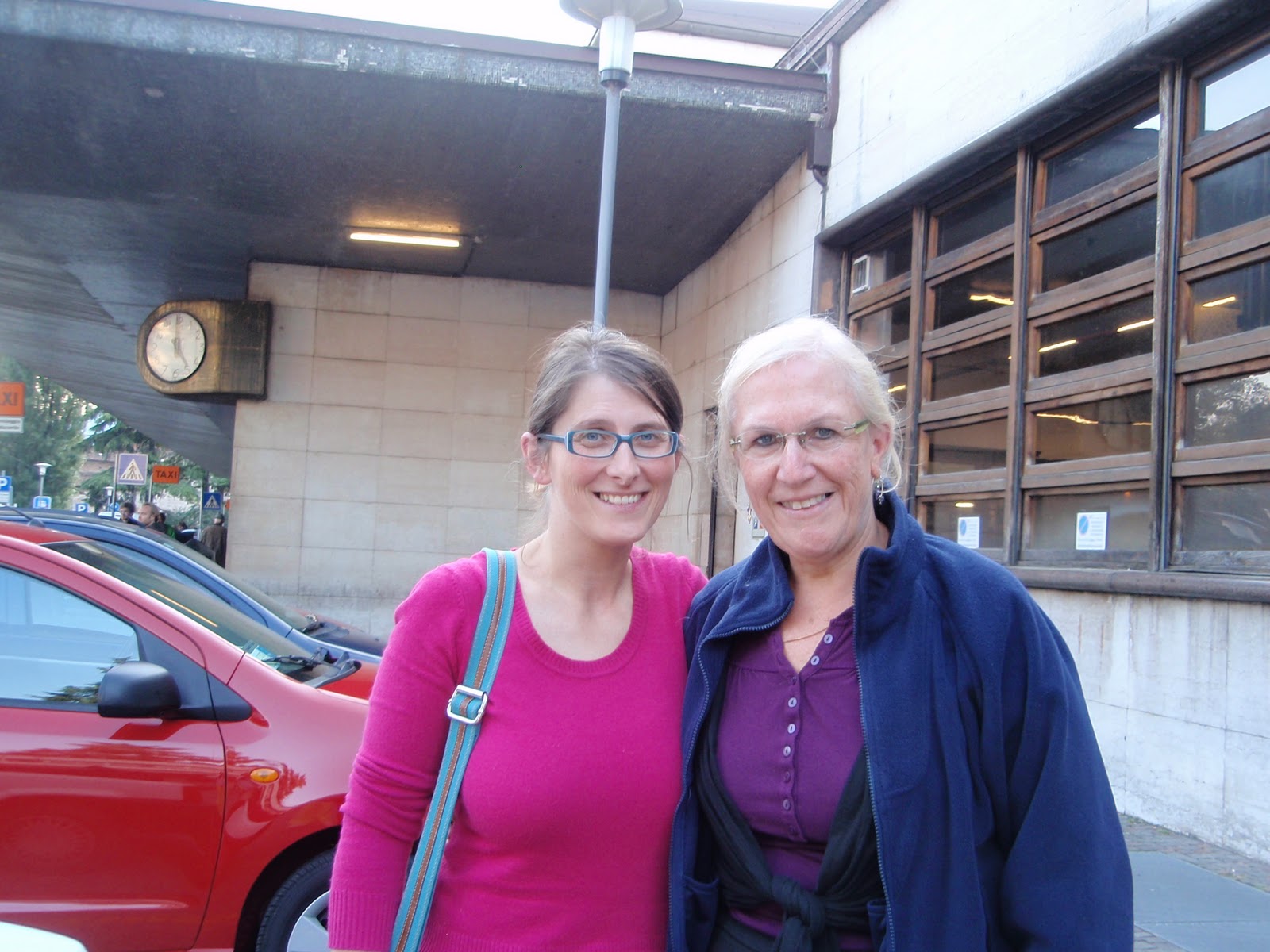
with Lucia at the train station in Trento, 2010
On Wednesday mornings, I often meet with Marco, a pediatrician from Modena. We've visited each other in Italy many times, in Modena, Parma and Zagarolo. Now I will also be talking with my new friend from Puglia on Wednesday afternoons.
w Marco in Parma, 2009
Thursdays I do double duty: first, I talk with Gianluigi,  a new friend, who lives in Padova. Then I meet with another Domenico, who lives in a beach town in Le Marche on the Adriatic Coast. We've been meeting on Skype for over four years and I've visited Domenico and his family several times. Domenico also has French penpals, and is working on his specialist degree in Engineering.
Domenico, from Grottammare, via Skype
On the weekends, I often talk with Enzo, who lives in Salerno, south of Naples. Enzo recently came to the U.S. for the first time, for a honeymoon in Florida! Our conversations are always animated and informative. From Enzo, I hear about the difficulties of being young and establishing a career in Southern Italy, where job opportunities are limited, despite one's education and training.
Enzo, via Skye
There are other Italian friends that I communicate with by email: Lidia, in Rome; Renata in Parma; Paola in Florence; Monica in Paris. And many more contacts have come and gone, as our needs and lives have changed. But my core of friends in Italy has grown each year, and continues to expand.
w Lidia in Rome, 2009
w Renata in Parma, 2009
With all these Italian connections,  it's easy to understand why being in Italy is so compelling, and so rich. I'm eager to return, but in the meantime, I'm grateful for the ability to have daily interactions with i miei bei amici, my lovely friends.

Thursday, January 5, 2012

Bonfires: Epifania e Panevin

photo courtesy of Life123.com
January is a time when I review the previous year and  map out goals for the new one. I recently read of a tradition that is performed tonight, on the eve of the Epiphany, in some regions of Italy. Many people know about the Italian tradition of Befana, the old woman who delivers gifts to children while they sleep tonight, but there's another tradition that has caught my attention this year. Bonfires to mark the new year are a popular tradition in Northeast Italy. Given its prevalence, there are many versions and names: in Friuli it is called pignarûl, while in Veneto they refer to the event as panevin, from bread and wine, the simple food that is consumed during the event.

The bonfire is made from a heap of dry branches, brushwood, or firewood. As the fire burns, everyone throws on the pile whatever is no longer needed. Furniture, clothes, even mementos are added to the fire. A puppet, representing an old lady, is often placed on the top of the pile; this figure represents all mishaps and calamities during the past year, and burning it effectively obliterates any traces of those events.

We can't build a bonfire in our backyard, but my son and I have decided to celebrate our own panevin, using a firepit that was a Christmas gift. We intend to write out the things that we would like to forget or let go of, our "calamaties" from the past year, and clear the way for new beginnings. I am currently planning out my next three month stay in Italy. In March, I'll spend a few weeks in Puglia, a region that I know little about and have never seen. My son is planning a longer trip: a 2-year bicycle journey, from Kansas to South America. So we are eager to let go of anything that could hold us back from our goals: instead, we'll invite visions of our future travels as we gaze into the fire.

Tuesday, January 3, 2012

New beginnings


 il cielo Michelangelesco, a Michelangelo sky in Kansas
January is named after Janus, and the name has its roots in Roman mythology, coming from the Latin word for door: January is the door to the new year! Janus is the god of beginnings, transitions and endings. Romans believed that the beginning of anything was an omen for the whole. This concept resonates deep within me: just think, whatever I start anew has the potential of affecting the cosmos, much like a butterfly effect. It reminds me that I must take care to focus on positive thoughts, acts and emotions.

For the past several weeks, I have immersed myself in the study of Roman history, in particular the time of Julius Caesar and his successor, Ottaviano (Caesar Augustus). I've been watching many documentaries and films that recount that period in history, and find it fascinating. Learning of the life and times of historical figures such as  Caesar, Mark Antony, Augustus, and Cleopatra helps add to my eagerness to return to Rome, where there are remnants of their existence still in evidence. In fact, I leave for Rome in 10 short weeks, and will arrive on March 15, the date that Julius Caesar was assassinated by his fellow senators. Non vedo l'ora di arrivare!  I can't wait! Soon I will be able to walk along la Via Appia Antica, the Ancient Appian Way, the same road that the ancient Romans used in their travels and conquests.
 
My new year began in Wichita, Kansas, the town of my birth, where I went for a family holiday gathering. I come from a large family of seven children. We have now grown into a far flung group of over 50, with members living in California, Colorado, Utah, Washington, Florida, Ecuador, Costa Rica, and Italy. For this gathering, there were 31 of us, and we had an unusually temperate day, with 60 degree (17 celsius) temperatures instead of the cold and snowy weather that is common in Kansas at the end of December.

It seems only fitting that I returned to my own roots as I contemplate the New Year with its door to new beginnings. I am eager and curious to see where this door will lead me...but for now, my wish to all is this:

Buon Anno!