Showing posts with label Zagarolo. Show all posts

Friday, June 22, 2012

La Bellezza: It's that wild beauty I miss!

Entrance to a nearby house in Italy: what a lovely welcome home!
Since my last post, I've returned to the States, spent three days minimizing the jungle of weeds that had sprung up in the yard during my three month absence, and plunged into 50-hour work weeks that will last until the end of June. Ergo, I've had very little time to write.

Poppies were blooming everywhere!
As people continue to ask me if  I've "adjusted" to being in Kansas again, I've been thinking about the differences between my life here versus the life I have in Italy, and am eager to share some of those thoughts in an upcoming post. For now, the biggest difference I'm noticing is the absence of wildness, the profusion of flowers, the pungent perfume of flowering trees and bushes that were so prevalent. I miss the vibrant views and scents that are a constant at this time of year in Italy. When I take walks here, I see square yards with neatly mown lawns, but there are few flowers and no scents wafting down that street, as there are in Zagarolo. Sure, we have many flowering trees in  April and May, and the city does a great job of creating vibrant displays of flowers through the summer months, but lately I've mostly seen green: trees and grass.

How I miss the profusion of fragrant Gelsomino (Jasmine)!!!
Until I have time to write at length, here are some photos I took of various plants that were blooming EVERYWHERE in Italy. From Puglia to Liguria, Veneto to Lazio, Tuscany to Basilicata, I miss the constant presence of poppies, jasmine, ginestra, roses and other blooming flowers, vines, bushes and trees that were evident during my travels this spring.

Ginestra (broom): a sweet smelling bush we don't have in Kansas
At least my yard has a  few blooming flowers, but it's a meager show compared to the wild beauty that was always on display in Italy. However, as a solace, I bought a sweet bouquet this week for only $3! The rich colors are vibrant enough to make up for the lack of any scent. I'm hoping there will be more bouquets like this to sustain me through the summer.

I'm a sucker for purple and red bouquets.
And I have a small atomizer with  the scent of flowers from the Tiglio (linden) tree that Lucia bought me last year when we visited a park in the mountains of Trentino. I spray the honeyed scent of Tiglio in my bedroom before sleeping, and it seems to sweetens my dreams. Or as they say in Italy, it brings me sogni d'oro (dreams of gold)!

Tiglio flowers (http://bellabiker.blogspot.com/)

Wednesday, April 18, 2012

Market day in Zagarolo

On the weekends, there are two large open markets in Zagarolo. I usually shop on Saturday, when several parking lots in the centro storico fill with vendors selling fruits, vegetables, meats, cheeses, breads, honey,  jams, olives, and much more. There are also vendors selling clothes, shoes, kitchen ware, toiletries, jewelry, gadgets of all kinds, and even underwear and socks.

On Sundays, there's a smaller market, which only allows vendors selling food grown or made locally, which is often organic. This is where you find the fresh arugula and fava beans, the newly made ricotta, the bread fresh from the oven. Only food that is in season is sold, so the selection is limited. Right now, that means no fruit, tomatoes, zucchini or eggplant. So the Saturday market works better for me, as I can find all I need for the next week in one place. And the flavors! After often eating tasteless fruit and vegetables in Kansas all winter, the flavors of Italian produce are a feast in themselves!

Here's a sample of what you can get for 6 euros at the Zagarolo Saturday market (it would cost much more at home):

Fresh from the market
4 cipolle rosse red onions
1 peperone gigantic red pepper
1 zucchine
4 mandarini mandarin oranges
3 arancie blood oranges from Sicily
3 mele golden delicious apples from Trentino/Alto Adige
2 cestini di fragole  pints strawberries
1 grappolo di pomodori bunch of Roma tomatoes

Tuesday, April 3, 2012

Zagarolo ancora

iris
It's peaceful here in Zagarolo: my friend Deborah has just left for two months of adventures, while I'm here to look after her house, garden and cats. I arrived here on Friday night, after two weeks of travel in Puglia, and I'll have many stories to share in the weeks to come. But for now, here are some photos of what is blooming in the yard.

baby figs!
Best of all: a peony tree with scads of flowers! (but no rich perfume, like the peonies at home)

Saturday, July 30, 2011

Last days

Sunset view in Zagarolo

My last few days in Italy were spent hanging out in Zagarolo with Deborah, doing some online work, and packing my bags for the return trip to the States. I have the chance to return to Zagarolo next year, for two months in the spring, and another two months in the fall, so that helped to modify my sadness about leaving my new "home." And if all goes well, maybe I can stay in Italy in the months between my stays in Zagarolo. Chissá? I even left a bag of clothes and toiletries at Deborah's house, that I can use when I return.

I decided to spend my last night in Rome, as there was a nationwide train and bus strike the next day, and I didn't want to be stranded in Zagarolo without a way to get to the airport. As it turned out, the strike didn't start until after I left Rome, but I'm glad I had the chance to spend a few hours in Trastevere, where I had a wonderful meal of grilled calamari and zucchine, in Piazza della Scala.

YUM!!!

One of the smartest things I did before heading to Rome was doing  an online check-in and printing off boarding passes for my flight home, from my computer in Zagarolo. This enabled me to breeze by the long lines at the check-in area at the airport. I stayed in a B&B called Little Italy, which is only a short walk from the Termini train station. From Termini, I took the Leonardo Express to the Fiumicino airport, and hopped on a shuttle to Terminal 5, where direct flights to the U.S. depart. I bypassed the check-in area, dropped my bags off, and proceeded to the departure gate. After the incubo (nightmare) I had last year at Fiumicino, I was determined to become more familiar with the airport, and am pleased to report it went well. Here's link to last year's fiasco: Foulup at Fiumicino

In Kansas I was greeted by HOT weather, the hottest July in 100 years. For nearly three weeks, the temps were in the 100's F (38-43 Celsius), searing off blossoms on growing plants so that vegetable crops have been decimated. No tomatoes in my orto (vegetable garden)! But the basil is doing well, so at least I'll be able to make fresh pesto. And here I was worried about the heat in Italy, when in fact, hot temps were rarely an issue during my stay.

I'm adjusting to life in Kansas, and prolonging my re-entry by continuing to share stories of life in Italy.

Monday, June 27, 2011

Food of the Gods (and Goddesses)

Figs!
Suddenly, I have a bumper crop of fichi (figs) on my hands. I've never had fresh figs before, and with such a quantity, I've been doing research to find some recipes that don't involve using them for jam or desserts. To my delight, I've found many that pair figs with prosciutto or cheese, and suggest using them in salads and on pizza.

Did you know that the fig is one of the first plants cultivated by humans? Fig fossils dating back to 9400 BC prove it! It's even believed that they could have been planted and cultivated intentionally, one thousand years before wheat and rye were domesticated. Figs also served as a common food in Roman times. And as for nutrition, figs are one of the highest plant sources of calcium and fiber. But they also have a laxative effect, so it's best not to eat many at one time.

(postscript: later, I learned that this crop of figs is basically of no value. Usually, they drop to the ground and are not used. In September, the sweeter figs arrive, the settembrini, which are much juicier and sought after.)

I have some other beauties in the yard, including melagrana (pomegranate), which are just starting to form their fruit, as shown below.

I neglected the carciofi (artichoke), but now have a lovely plant to watch as they go to seed.

And these aren't plants, but I enjoy their shape: demijohns once used to store wine, that were rescued from rubbish bins.

Sunday, June 26, 2011

Sagra del Tordo Matto

La Sagra in Zagarolo

When food is in season and plentiful, Italians celebrate with a sagra, which is basically a food festival or fair. With summer upon us, the sagra season is in full swing, with nearby villages offering various types of food specialties to entice people to celebrate with them. Some examples: Sagra del Cinghiale (wild boar), Sagra della Fragola (strawberries), Sagra della Lumaca (snails), Sagra della Vongola (clams), and in Zagarolo, the very unique Sagra del Tordo Matto.

Tordo Matto (crazy thrush): a roll of horse meat, (usually locally bred), seasoned and stuffed with a mix of prosciutto lard, coriander, parsley, sage, garlic, salt and ground red pepper. Sounds yummy, huh? This is what's being featured this weekend at Zagarolo's annual Sagra del Tordo Matto.

The sagra is usually held in the main piazza, and vendors set up stalls to sell all kinds of fare, from local food to candy, clothes and jewelry. Usually a communal meal is prepared, and long tables are set up in the piazza. Larger sagre have musical entertainment or some type of competition. The sagra season usually starts in June and continues through the fall months.

The preparation of Zagarolo's Tordo Matto is closely linked to the rural economy of the country. Traces of Tordo Matto go back to the 1800's, thanks to some photographic evidence depicting the first "crazy thrushes" cooked on a spit. From an essay written in 1820 it is clear that the spread of this dish was mainly due to a large horse and donkey population. It was a time when Zagarolo lived only for agriculture and sharecropping. The thrush was a delicacy for the richest, and when farmers ventured into the woods in search of animals to hunt, they seldom met with success. As a result, they were forced to kill older animals used in the fields, like donkeys or horses. And since the meat of the horse and the donkey was too sweet, they created a way to make it more spicy and appetizing.

The legend of the "mad thrush" goes back even further, to the sixteenth century when Zagarolo was under the domination of the Colonna family. A wounded soldier took refuge with a farm family who offered him wine and horse-meat rolls made with lard and spices. The drunken soldier began to play the fool and kept repeating the word "drossel" or "thrush" in German, and because he seemed crazy, the meat rolls evolved into "Tordo Matto". Whatever the origin, each year the Zagorolesi honor the tradition by having a sagra where they serve this dish.

I've been to a few sagre, and some are more interesting than others. I especially enjoyed the Sagra delle Castagne (chestnuts) last fall in Marradi.

2010/10/marradi-sagra-delle-castagne

I missed out on the main events of the Zagarolo sagra, which happened on Saturday night, because I was unaware that it was going on. But today I made sure to be on hand for a lesser version of the festivities. As sagre go, it was small and uneventful, but I was there early in the evening: I didn't stick around for the communal cena (meal) and musical entertainment, scheduled to start after 9 p.m. Instead, I took a pleasant passeggiata through the town and returned home. My main goal was to have a taste of the legendary "tordo matto." Here's what I got: a small meat roll between two slices of bread, for 3 euros. Nothing fancy here. Actually, the meat roll was quite tasty, though it could hardly serve as a meal. Still, I can imagine how it might substitute for a roasted, stuffed bird in a pinch.

Il Tordo Matto

Much later that night, I heard fireworks for what seemed an interminable amount of time, more than an hour, so I'm guessing that things picked up at the sagra after I left.

When I told my friend Massimo in Bologna about the sagra, he said that the tordo brings to mind another comic event for most Italians: a scene from a movie by the comedian Paolo Villaggio, who plays a character called Fantozzi, a "common man" who continually gets into trouble. Here's a link to a scene that shows Fantozzi attempting to eat il tordo for the first time, while his upper class companions look on in disgust.

Goditi!
Enjoy!
Fantozzi - Il Tordo

Saturday, June 25, 2011

Tesoro

a rendition of me, by Francesca

Tesoro is one of my favorite words in Italian. Literally, it means treasure, but is more commonly used as a term of endearment that parallels words like darling, sweetheart or honey in English. Then there are also words like cara, and carissima (dear, dearest), amore (love) and bella (beautiful) that one routinely hears in conversation. In fact, I rarely get greetings from Italian friends that do not begin with cara or carissima: by phone, email or in person, words of love are common greetings. I often wonder what it would be like to grow up hearing a daily litany of words like "beautiful," "dearest," "darling," "my treasure." I rarely hear Italian parents talking to their children without freely using terms of endearment, whether they are giving a command or praising them. Italians enjoy using superlatives and it can't help but have a positive effect on one's psyche. After being greeted this way almost daily for several years, I've become quite spoiled, and now expect to hear it.

But today I'm using the word tesoro to describe a real treasure, offered to me by five-year-old Francesca, who lives next door. A happy, precocious child, Francesca greets me with a sweet "ciao, Maribett" every time she sees me (the Italian tongue has trouble with the "th" sound, and there is no y in the language, so here I'm often called Maribett.) Her parents are also friendly, but Francesca goes out of her way to greet me often. When I was in Rome the other day, I came across a street vendor selling trinkets, and I bought a few for Francesca and her older sister, Sara (a 12-year-old who is more likely to scowl). As soon as Francesca received her gift (a small glass bear), she ran inside to create the above drawing, which now has a place of honor on the refrigerator. Tesoro, indeed! And for once, Sara also smiled. Evviva! (hurray!)

Friday, June 24, 2011

Albicocche, Prugne e Zanzare

plums, apricots, pine nuts

Oh, how Italians love their fruit! And it's no wonder, as something is always in season, and you make the most of each fruit as it becomes available, so luscious and fresh from local vendors. Fruit is often eaten as a dessert, both at il pranzo (lunch) and la cena (dinner), and I heartily enjoy this habit. My Italian friends all relish eating fruit and vegetables (as do I), a habit that is sadly missing from the American diet. It seems that in the States, we have to bribe our children to eat their fruits and vegetables, while they are prized foods in the Italian home, starting from infancy. I think a lot of it has to do with the fact that fresh fruit is delicious and is readily available in Italy most of the year. We don't have access to fresh fruit many months of the year in Kansas, and eating fruit that has traveled many miles just doesn't have the same quality of flavor.

Over the past few days, it's been heating up, into the 90's F (30's C), and the plum tree near the patio has been dropping fruit nuggets in the yard. They're quite small, and it feels like an Easter egg hunt to look for them in the leaves beneath the tree. In the photo above, you can see today's stash of le prugne (plums) from the back yard and gli albicocche (apricots) from the neighbors. Next to the basket is a pine cone from the Pino marittimo, or Maritime Pine, which gives us pine nuts (used to make pesto), covered by a hard brown shell. I've tried cracking a few of them, and it's hard work! Now I know why they cost so much.

Along with the heat come le zanzare, the mosquitoes that will plague Italy until it freezes in the fall. Purtroppo, unfortunately, the little buggers love to bite me, so if I want to have any kind of ventilation in the house, I have to use a mosquito zapper, starting in the late afternoon and continuing until morning. Window screens are not usually included in Italian houses, so mosquitoes have free entry whenever the windows or doors are open.

To ward them off, I use a handy little zapper that plugs into the wall. You slide a small pellet into the round ball, and it heats the pellet, perfuming the air with something that keeps mosquitoes at bay. A pellet lasts for 12 hours, and I've been using one every single day.

Tonight there's a fresh breeze in the air, and it's calling me outside for another long walk.
Buona sera! (Good evening!)

Thursday, June 16, 2011

Romans come to visit

fMy friends Lidia and Carlo came to spend the day with me, so I took them to Castel San Pietro, which they'd never seen before, though they've lived only 18 miles away for most of their lives. It was fun to their tour guide, for a change.

It was the perfect day, still cool, but sunny. If you'd like to know more about this charming village, I've written previously about it here:

castel-san-pietro-romano

When we got back to the house, I fixed gnudi again, and they pronounced my efforts Buonissimi! Squisiti! (= YUMMY) High praise coming from a great Roman cook and two Romans who are used to eating good food. After their comments, I feel more confident about my attempts to cook Italian for Italians.

Wednesday, June 15, 2011

A visit to the Cantina

Me and Marvi

After our trip to Tivoli, we stopped in at Cantina del Tufaio to visit the real cantina (wine cellar) where the white wine is stored. The cantina was dug out of the tufa rock by Claudio's grandfather in 1850, and serves as the perfect cooler to store the wine while it ages.

The stairs down to the cantina

Claudio explains the storage of wine

Sharing a toast with the new Spumanti

After visiting the cantina, we sat under the pergola on their patio and tasted a new bottle of their Spumanti, along with ciambelle (cookies made to be eaten with wine), bread and last year's olive oil. One of Claudio's winemaking friends stopped by to have his wine "tested" by Claudio, and we all had a glass of that as well. Since everyone was Italian but me, as the conversation sped up, it quickly moved beyond my comprehension level. But I enjoyed the chance to while away the afternoon with several groups of friends, brought together by yours truly!

A view of the pergola

Sunday, June 12, 2011

A gift and guests from Modena

Fountain of the Nymphs, Piazza Repubblica, Roma

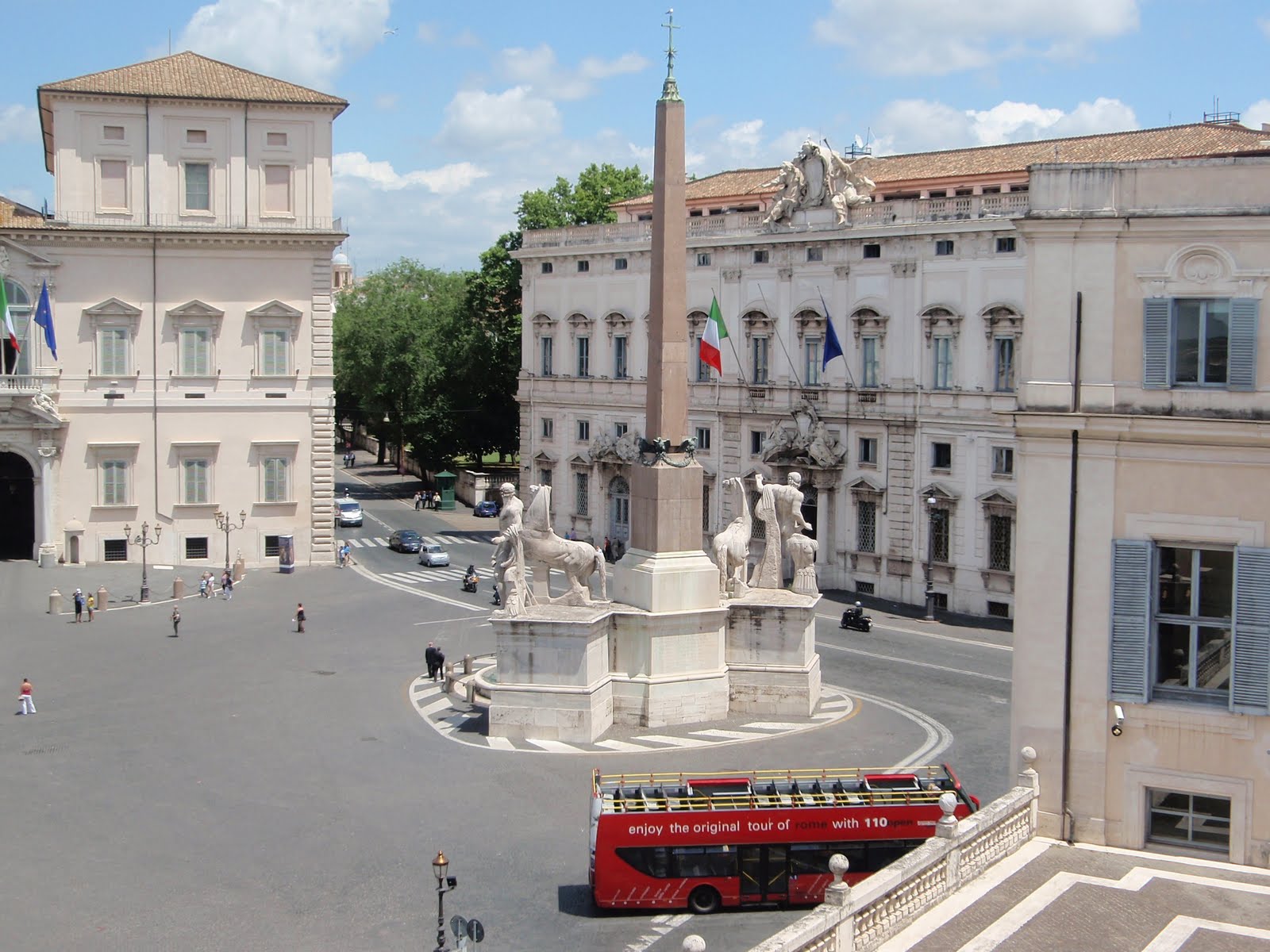
This week I had visitors from Modena: Marco and Marvi came to spend a few days with me in Zagarolo. I met them in Rome at the Termini train station, and we headed down via Nazionale and over to the Scuderie del Quirinale to see an art exhibit by Lorenzo Lotto. (Across the piazza is Palazzo Quirinale, the official residence of the President of the Italian Republic, currently Giorgio Napolitano.)

Piazza del Quirinale

I was not familiar with the artist Lotto, originally from Venice, who was considered eccentric and independent from his cohorts, who included Bellini, Rafael and Bramante. Due to recent restorations of his work, the colors were vibrant, and I found the exhibit to be powerful and impressive. For more on Lotto, click this link:

Lorenzo_Lotto

After the exhibit, we took a taxi over to the Pantheon, asking the taxi driver for suggestions as to where we could eat a good Roman meal. Bypassing the outdoor cafes catering to tourists, we had a wonderful lunch on a side street near the Pantheon. Then we walked over to the Trevi fountain and Piazza Navona before making our way back to the train station.

Bougainvillea viewed in Piazza Navona

When we returned to Zagarolo, after giving a tour of the house and yard, I made my new specialty, gnudi for la cena (dinner). It turned out quite well! And for dessert, a special Cherry-Olive Oil Polenta cake that I'd made in honor of Marco's upcoming birthday.

I was pleased to have Marco and Marvi as my first guests in Zagarolo, and look forward to spending several days showing them around my new home in Lazio. And lucky me! Marvi brought with her a small bottle of homemade aceto balsamico (balsamic vinegar), made from the family's 30-year-old store of grape must. For those who don't know, Modena is famous for its balsamic vinegar, and the best variety, aged at least for 20 years, is expensive. Most versions of balsamic vinegar in the U.S. have little relation to the real stuff. 

The History of Balsamic Vinegar

Balsamic vinegar is today used in numerous recipes all over the world. The tangy sweet and sour flavor of balsamic vinegar gives a marvelous finish to gourmet delicacies. Having its origins in the Emilia-Romagna region of Italy, balsamic vinegar has found its way into the smallest of home-kitchens as well as the trendiest of restaurants. One finds the shelves of supermarkets stocked with various brands of balsamic vinegar each claiming their own superiority. An average customer is unaware of the fact that authentic balsamic vinegar is very difficult to come by. Most of the commercial varieties available in the markets are manipulated versions or imitations. It would therefore not be surprising if we say that most people have not even tasted authentic balsamic vinegar.

Thirty years ago true balsamic vinegar, (or in Italian) “aceto balsamico tradizionale,” was relatively unknown outside of villas of Italy. Till this time, its production was restricted to the wealthy families in the small towns of Modena and Reggio in the Emilia-Romagna region, just west of Bologna. They had been making the condiment for nearly a thousand years but catering only to the requirements within the family. They would stock supplies for several years and pass on to the next generation as heirlooms. It was also a prestigious gift given in small vessels to close friends or bequeathed to daughters as a portion of their wedding dowry.

Grazie a Marvi! Now if I can only get the bottle home to Kansas without breaking it!

Monday, June 6, 2011

Le vigne

Uve a tavola (table grapes)

Vineyards

Today I went across the road to la vigna (vineyard) and cantina (wine cellar), called Cantina del Tufaio, to learn something about the grape-growing process. Claudio and Mariela were working on the vino rosso (red wine) vines under the hot morning sun, trimming away leaves that were shading the baby grape clusters, and tucking the long tendrils of vine up under the overhanging wire. They were explaining things quickly to me in Italian, so I wasn't able to follow everything they said, but I got the gist of it.

After a wind and rain storm yesterday, they were working hard to "clean" the vines before another storm that is predicted for this afternoon. Only the vino rosso vines need to be cleaned in such a way. The vino bianco (white wine) vines are treated differently: the vines are cut at the top, and the leaves are left to shade the grape clusters.

They were working in the newer vineyard, planted ten years ago, which contains one section of grapes for red wine (cabernet sauvignon) and another for white wine (chardonnay).

Their older vineyard, down the street, was planted in the early 90's. Mariela took me on a tour of this more expansive tract, which curved downwards along the hill and up the other side. The views were simply breathtaking. This tract contains a variety of grapes for other types of wine, spumanti, and merlot. These grapes were much larger, and will be harvested in mid-August. Beyond the merlot vines is an olive orchard, and beyond that is a walnut orchard.

Mariela told me that most of the houses in this area are relatively new, meaning about 50 years old. But the house where the cantina is located predates all the newer construction, as it was built in 1936. Houses that are older have often been refurbished with stucco on the outside, and small patches of the original stoneware are visible to show their more ''antique" origins.

I'm wishing I could be here in the fall to see the vendemia (grape harvest). Chissa? Forse posse ritornare...

Thursday, June 2, 2011

Cherries galore!

June 2, Festa della Repubblica


Though today was a holiday in Italy, as Italians celebrated the 65th anniversary of their independence day, it was just another day for me. I'd been to Rome earlier this week, so decided not to hassle with the city scene. Instead, I spent much of the day picking, pitting and cooking cherries.

After four glorious but hectic days in Firenze, I was ready to come back to the tranquil setting in Zagarolo. I'm enjoying my time here more and more. One of my routines is to take an hour-long walk down a country road, with views of vineyards and hills in every direction. I can watch the changes in the vegetation, and was surprised this week to see how much everything had grown while I was in Florence. Wildflowers of all types, colors and sizes had popped out, including orange poppies, blue chickory, white Queen Anne's lace, and pink primrose. In the yard, other varieties of wildflowers are blooming, along with the oleander and pomegranate bushes. (yes, a pomegranate! It has bright orange flowers. Who knew?)

Cherry pitting

And the two cherry trees are loaded down with cherries. There seems to be no end to them! I've been picking about 4 pounds of ripe cherries every day for the past four days, and there's no end in sight. I've made several cherry cobblers, am planning to make a Cherry-Olive Oil Polenta Cake for friends who are coming next week, and tonight I'll try my hand at cherry jam for the first time ever. As for the rest, I'll probably freeze as many as I can for Deborah to enjoy when she comes back. I've also been eating them by the handful; they're just too good to pass up. However, many of them will go to waste, as the trees are too high for me to reach all the branches. When I took a tray of cherry cobbler to one of my English students, I returned with zucchine and gigantic mulberries from their garden. Nice trade!

A bounty of cherries, and cherry cobbler.

One of the best things about house-sitting, as opposed to renting, is that I have access to a fully equipped kitchen, complete with a cherry-pitter and all the other utensils I need to cook, bake, make pasta, jam or whatever else suits my fancy. However, there's no food processor, so I have to beat the cake batter and chop by hand, and I'll be using a mortar and pestle to make pesto when the basil is ready. And then there's the garden: I have fresh lettuce, arugula, artichokes, basil, and soon, tomatoes! I am so thankful to have such a lovely home in such a beautiful setting to take care of for several months.

Wednesday, May 25, 2011

Zagarolo vs. Firenze

The view I see on my daily walks in Zagarolo

I'm getting ready to go to Florence for a four-day stay, and I'm curious to see what it will be like, after living in a completely different kind of setting. Now that I've been living in rural Zagarolo for a month, I've been able to evaluate how life here contrasts with my life in Florence last fall.

Noise: Here in rural Zagarolo, tranquility is a constant. No sirens, buses or the constant sound of foot traffic and late night revelry to deal with. Instead, I hear birds singing throughout the day, roosters crowing, dogs barking, the wind in the trees and the music of wind chimes. Lawn mowers, weed whackers and tractors can often be heard. But mostly, it's quiet here, and I love it. The sounds I miss most from Florence are the chiming of the church bells, and the sound of bicycles rattling along the streets.

Walking in Florence

Nature: I'm also surrounded by nature here, in all her glory. Verdant green and rolling hills provide a backdrop to a way of life that is still largely agricultural. One of the things I found most painful about living in Florence was the lack of green space, and the difficulty of finding a place to enjoy the sun, due to the closely built, tall buildings. I feel more at home when I'm in a natural setting, and can't imagine living in a city for long stretches of time due to that fact.

People: In Florence, I often saw more tourists and stranieri (foreigners) than I did Italians. Here, I never see tourists, sometimes see foreigners, but mostly, I'm surrounded by Italians. And though the Zagorolesi are not openly friendly, they readily respond to my "buon giornos." I've seen many an elderly person's face light up when I greet them on the street, and their pleased reaction is always welcome.

Culture: In this respect, Florence wins, hands down. There is little culture here, but Rome is in close proximity, with culture galore, if I want to partake of it. However, I prefer the Florentine brand of culture: it's more creative and elegant. I miss having easy access to unusual, often spontaneous creative events that occur daily in Florence.

Clothes: Out in the country, there's no great need for elegant clothes, and in that way I feel more at home here. In Florence, I was more concerned about my appearance when I went out walking. Here, dress is more casual, and less creative, but more comfortable! I've noticed that long pants are the norm, and my capris always seem to stand out when I go into town. But I miss seeing the elegant, creative style of Florentines, and will enjoy having the chance to view their spring and summer attire this week.

Driving: In Florence, I enjoyed living in the centro storico, amidst the main events going on. I had no need of a car, and could easily get around via public transportation, when necessary. I routinely walked for several hours a day, which was both good exercise and a social outlet for me. Here, my walks are more enjoyable due to the scenery and the serenity of the setting. I've also come to enjoy driving the winding roads, and being able to explore nearby towns.

Temperature: A big plus of life in the country is the fact that it's cool and fresh at times when the city is uncomfortably hot and the air is polluted. I'm so thankful to be living in a setting where it stays cool. In Florence, temperatures are already in the 90's, and with no AC, there's no way to escape the heat, except to leave town.

All in all, the life I have here in Zagarolo is probably more suitable to me for a long-term stay than living in Florence. If I could have live in a country setting closer to Florence, that could be the perfect solution. But for now, I'm eager to be in Florence again and see what's new.

Monday, May 23, 2011

Ospiti! Vino!

Guests and Wine
Now that I’ve become more habituated to life in Zagarolo, I’m ready to have some guests. Marco, a friend from Modena, expressed an interest in coming to Rome while I’m here, so I invited him and his wife, Marvi, to spend some time in Zagarolo. I’ll meet up with them in Rome in a few weeks, then bring them here to spend a few days exploring some of the hill towns in the area, perhaps even go to Tivoli. Bolstered by that plan, I also invited Lidia and Carlo, a couple from Rome, to spend a day in Zagarolo with me sometime soon. Another friend who lives in Ostia, on the coast west of Rome, invited me to visit him in June and wants to come here to visit the nearby winery. This gives me more incentive to check out more of the area before my guests arrive.

The other day I drove to Colonna, another hill town that’s about 10 minutes by car. Unlike Castel San Pietro, I wasn’t too impressed. Oh well, there are many others still to see. I have found several roads that have lovely scenery alongside them: one is the road to Tivoli, which only a 15km drive from here.

When I got back to the house, I noticed that the gate to the winery across the road from the house was open, and decided it was the perfect time to meet the owners. A man was driving up to the entrance just as I arrived, and he went looking for the owner, who was out in the vineyard. Then the wife of the owner came out, and I introduced myself. Deborah had told them that I would be staying here for several months, and that I was interested in learning about the growing and making of wine.

Entrance to winery

In fact, I’d met Claudio and Mariela in 2009 when I was in Zagarolo the first time, but I didn’t expect them to remember me. The other man turned out to be a restaurateur from a restaurant in Tivoli, one of the towns on my list to visit. Bottles of wine were brought out to sample and enjoy with bread, olive oil and cheese while we talked.


The Tufaio winery:
From their website, http://www.cantinadeltufaio.it/ I learned that “The Winery "Tufaio Cellar," located in the heart of the DOC* Zagarolo, was founded in 1994 by the Loreti heirs to continue a tradition that has its roots in 1881. The cantina was created inside the farmhouse built by Tiberius Loreti, and includes a cave, dug by hand in the tuff** about 20 meters deep. The name "TUFAIO" celebrates the tufa of volcanic residue in the vineyards that give our DOC and the smell of "wet tuff", typical of the best wine in Zagarolo.”

*DOC Denominazione di origine controllata ("Controlled origin denomination") is an Italian quality assurance label for food products, especially for wine and cheese. It means that products are guaranteed to originate from certain areas, and are produced by specific standards.

**Tuff: a type of rock consisting of consolidated volcanic ash.
I'm thrilled with the prospect of having guests coming to stay with me in Italy. Now I've got to get my act together and make it worth their while!

Saturday, May 21, 2011

Finding the Treasure


I’ve been reading an unusual and interesting book that Deborah suggested: A Fortune-teller Told Me: Earthbound Travels in the Far East, by Tiziano Terzani. After being told by a fortune-teller in Hong Kong not to fly for a year, the author, a long-time journalist in Asia, decided to heed the warning and spent the year traveling across Asia by many other modes of transportation. The book is an account of that journey. Terzani was born and lived the first 18 years of his life in Florence, but became fascinated with the Orient in his 20's and lived most of his life in various parts of Asia.
In the book, Terzani writes: “Every place is a goldmine. You only have to give yourself time…and soon, the most insignificant place becomes a mirror of the world, a window on life, a theatre of humanity.”

This week, as I’ve settled more into the daily habits of life in Italy, I readily agree with Terzani. For the first few weeks, I was intimidated by many things, but now that I’ve become familiar with the daily chores and activities, the driving, the neighbors and the neighborhood, I’m realizing what a treasure I’ve found.

Terzani also writes at great length about the power of belief, as he visits many cultures that have strong beliefs in magic, and observes that it is one’s beliefs that create, or at least facilitate much of what happens in life. He relates how Christian missionaries, after years living amongst people who use ancient rituals for healing, often find that the beliefs of the people they were once trying to convert make more sense, and have more value, at least in that setting, than their own Christian beliefs.

I have long believed in magic, and for many years have taught others about the power of our thoughts. My journey in Italy has come about by virtue of my beliefs and the use of my mind to create a life that challenges, inspires and fulfills me. Several years ago I began to envision living in Italy near a small village, and here I am. It hardly seems possible, but it’s true. And the more I settle into that reality, the more eager I am to clarify my visions of the future. I’ve fully realized many of the goals that I set a few short years ago. So what’s next? I need to think carefully about what I want to experience, and this is the perfect place to fashion goals for the next five years. Undoubtedly, Italy is in my future, and I will be living in Italy more in the years to come. But the specifics are still vague and unformed. The desire is sufficient to lead me forward.

In the meantime, it is essential to savor my time in Zagarolo, and make the most of this trove of treasure that is currently my home.

Sunday, May 15, 2011

The peaceful village of Zagarolo


The countryside

Today I got up early to walk along the road by the house. I've done so many times before in the afternoon or evening, when there is usually traffic and activity from cars, dogs, tractors, etc. This morning it was more peaceful, and I even encountered several other women walking for exercise.

Around here, homes are all gated and often obscured from view, but beyond the homes there are vineyards, hills, and a few open fields. A few things that mar the walking experience are the whizzing cars that don't swerve around you (it seems they expect you to get out of their way, and sometimes pass by with only a few inches to spare), and the proliferance of large dogs, which seem to be the alarm system most often used in these parts. The dogs are usually behind gates, but they bark when anyone walks by, and some of them appear vicious.

The street I walk runs north and south (sort of), and the hills are to the east and west (or thereabouts). Directions are a little skewed here, as nothing seems to be laid out in a direct line like we're used to at home.

A view of the green hills surrounding Zagarolo

A peaceful village

Later, I drove the winding road into Zagarolo, an activity I'm beginning to enjoy. The roads are narrow, but there's little traffic, and it's a pleasant journey into the village. Two small Italian cars barely fit on the narrow road, and there's no shoulder to provide leeway, so if you come upon a tractor or cyclists, there's an art to passing them with finesse. I enjoy the challenge! To and fro, up and down, so goes the road into Zagarolo.

The road coming into Zagarolo

Along the road, every house has its own vineyard, its own olive orchard. The hills are covered with the new growth of grapevines, and it's a lovely sight. Sometimes I can hardly believe I am here! Several years ago I had a vision, a hope of living near a small Italian village, but no real understanding of how it might be possible to bring that vision to life. Ma piano, piano (but slowly), it's come about, and here I am, living the dream.

Il vigneto, the vineyard: a common sight in these parts

In Zagarolo, I stop to buy gas, 10 - 20 euros at a time. Gas is sold by the liter here, and for 20 euros I can get about 12.5 liters, or 3.3 gallons. That means gas costs @ $9 per gallon in Italy. And you thought prices were high in the U.S.! People often buy a few liters at a time and try to make the most of it.

After that, I park the car and walk to the Bancomat and withdraw money to last the next few weeks. I don't need much, as my only real expenses are food and gas, and I earn 40 euros/week helping two women practice their English. I stroll down the main street of Zagarolo, which you can also do by going to Google maps, typing in Zagarolo, Italy, and choosing the street view (click on the yellow man). With a little bit of playing around, you will find yourself on Via Fabrini, or Borgo San Martino, the very streets that I walk along in the sleepy village atop the tufa hill.

I stop in for a cappuccino at Paola's bar, then continue down the street to Porta San Martino, which serves as a gate at one end of town. Then I turn around and walk back the same way, taking time to explore some of the side vicoli (alleys). The anziani zagarolesi (elderly citizens) sit together on new wooden benches that line the street, chatting. Young mothers pass by with their babies in strollers, often speaking into a cell phone as they go.

Porta San Martino and the street beyond, Borgo San Martino

In one of the piazzas, I come upon a smaller open market, with a display of vegetables and fruit for sale. Across the way, a man sells fresh fish from his portable stall. I notice a poster that advertises an addition to the weekly Saturday market: starting on Sunday there will be a weekly market of cibo artigianale (traditional, home grown or homemade food) from Rome. There is also a festival of some kind scheduled this Sunday, so I'm sure to be in Zagarolo most of the day to check things out.

Laundry day

Speaking of artigianale, I stop in for homemade gelato, trying a small cone of melon and amarena cherry (a sour cherry). Squisito! (Yummy!) All too soon, I'm back at the car, and heading on to Palestrina to fare la spesa (do the shopping.) Ah, Zagarolo, a me piace molto! (I really like it!)